


News
Joining hands with partners at home and abroad to create long-term value and achieve a mutually beneficial future for the industry.
Send Us A Message
When is brown fused alumina cost-effective for abrasive blasting?
When is brown fused alumina cost-effective for abrasive blasting?
When does Brown Fused Alumina deliver better value for abrasive blasting than lower-priced media? For procurement teams, the answer depends on cost per finished part—not simply price per tonne. Its hardness, cutting performance, and potential for repeated use can make it cost-effective for demanding surface preparation, particularly in systems that recover and reuse abrasive. However, savings depend on substrate requirements, grit selection, recovery efficiency, and disposal costs.
The strongest business case usually combines repeatable production, effective abrasive recovery, and a surface specification that rewards aggressive cutting. The weakest case is a one-off job where most of the media cannot be collected, or an application where that cutting action damages the substrate. Understanding the difference matters more than securing a small discount on the purchase order.
Start with the cost of an accepted surface
Brown fused alumina is an angular, hard abrasive produced through electric fusion of alumina-bearing raw materials. In blasting, its cutting action can remove rust, scale, and coatings while creating an anchor profile for subsequent coating. Those properties have commercial value only when they help produce the required surface without excessive processing, rework, or equipment wear.
A useful comparison is:
Blasting cost per accepted part = total attributable blasting cost ÷ number of parts meeting the surface specification.
For large fabrications, cost per accepted square metre may be more practical. Include landed abrasive cost, labour, compressed air or other energy, replacement media, equipment wear, dust collection, waste handling, and rework. Keep the boundary consistent: comparing one abrasive’s purchase price with another abrasive’s full operating cost will give a misleading result.
Also distinguish abrasive circulating through the machine from abrasive actually consumed. In a recovery system, a large mass may pass through the nozzle repeatedly while only a smaller quantity needs replenishment. Fresh-media consumption per accepted part is therefore more useful than total media throughput for estimating purchasing requirements.
Recovery is often the deciding factor
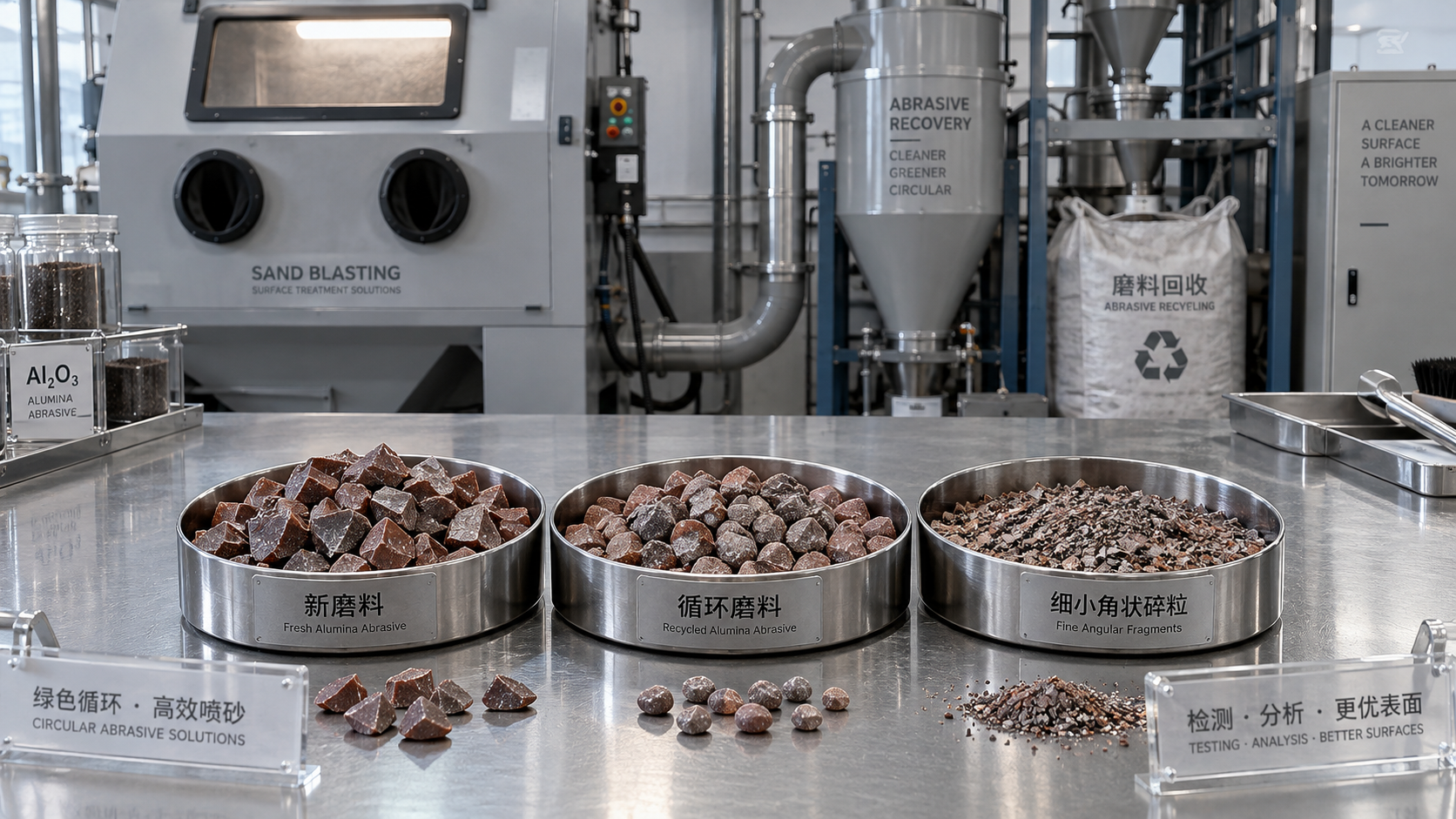
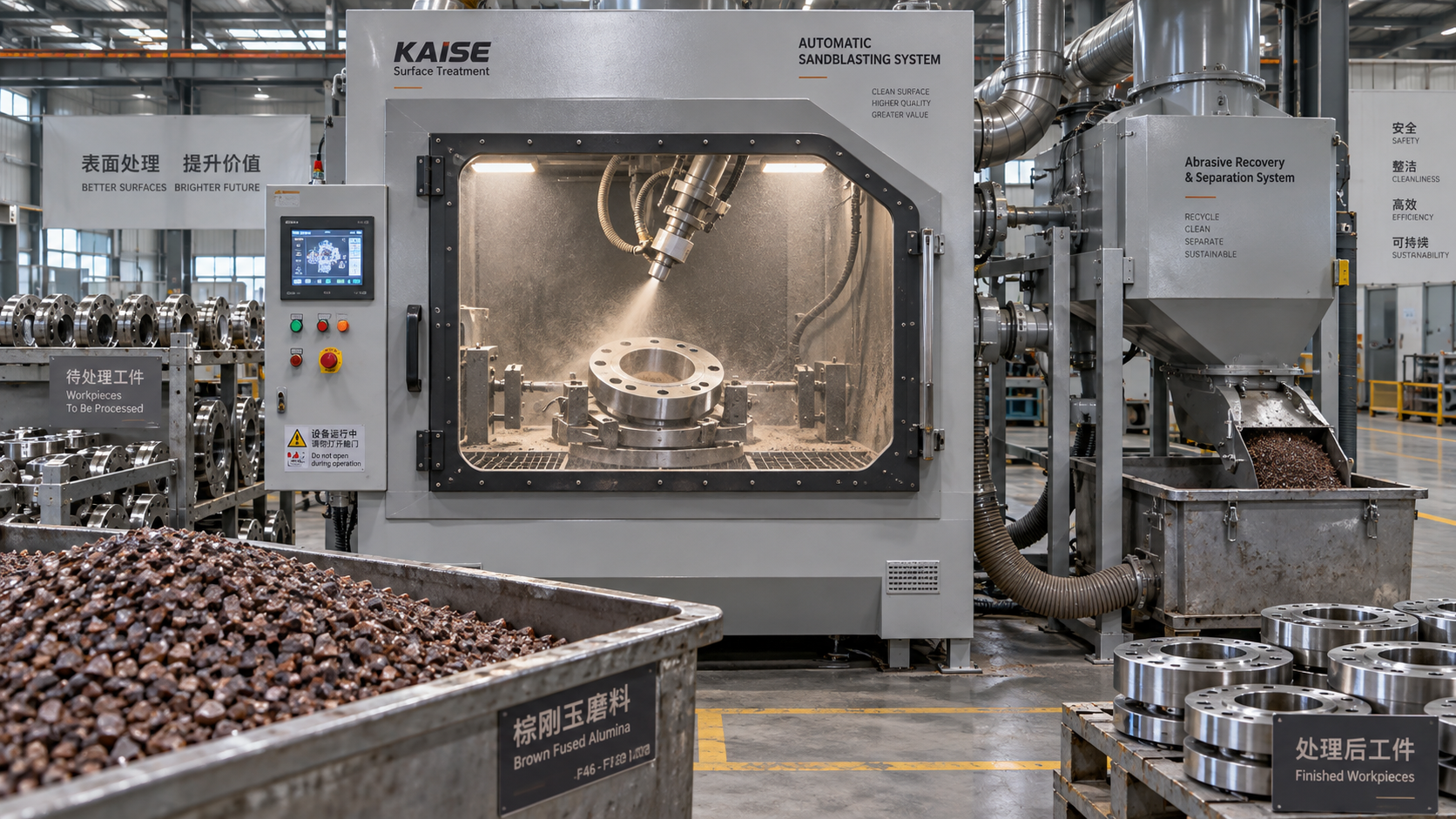
An enclosed blast cabinet or blast room with suitable recovery and separation gives brown fused alumina a better opportunity to offset its initial cost. Recovered particles can remain useful until breakdown, contamination, or loss makes replacement necessary. However, “reusable” is not a guaranteed number of cycles.
Actual service life depends on operating pressure, impact conditions, workpiece geometry, abrasive grade, and the condition of the recovery system. An inefficient separator may discard usable grit with the fines. Poor dust removal may leave excessive fines circulating, changing the working mix and reducing process consistency. Media can also leave the system trapped in cavities or carried out on components.
This creates an important purchasing distinction: an abrasive that survives impact is not necessarily an abrasive that your plant can reuse economically. If contamination prevents recirculation, durability offers little financial benefit. Likewise, improved recovery may reduce consumption more effectively than switching to a cheaper grade.
For open-site blasting without practical recovery, the reuse advantage largely disappears. Brown fused alumina may still be justified by cutting speed or a specific surface requirement, but that must be demonstrated. Lower-cost expendable media can be more economical where labour, finish quality, and waste costs do not outweigh the purchase-price difference.
Where performance can justify the premium
Demanding surface preparation is where a higher-priced abrasive has room to earn its cost. Removing adherent scale or preparing durable steel components for coating may require substantial cutting action. If brown fused alumina reaches the required cleanliness and profile faster, the saving can come from shorter blasting time rather than reuse alone.
That benefit is particularly relevant when the blasting station constrains production. A lower media price is poor compensation for a process that keeps operators and downstream coating equipment waiting. Still, faster production has financial value only if the plant can use the released capacity or reduce actual operating hours.
For chemical-industry equipment, surface preparation must also support the coating or lining specification. Reaching an acceptable visual condition does not by itself confirm that the surface is ready. Profile, residual dust, soluble contamination, and abrasive residues may need separate checks, depending on the project requirements. Neither abrasive hardness nor a supplier’s product description replaces those acceptance criteria.
More aggressive blasting is not always better. Thin sections, softer metals, precision surfaces, and components with tight dimensional tolerances may require a less aggressive medium or adjusted process. An unnecessarily deep profile can increase coating demand or fall outside the specified range. The economic target is the required surface—not the roughest achievable surface.
Compare alternatives against the actual job
Mineral slags and garnet may be credible options for expendable blasting, depending on grade, availability, surface requirements, and waste arrangements. Steel grit deserves consideration in compatible recovery equipment where metallic media and possible ferrous contamination are acceptable. Glass beads are generally evaluated for different finishing objectives; they should not be treated as an interchangeable replacement when aggressive cutting and an angular profile are required.
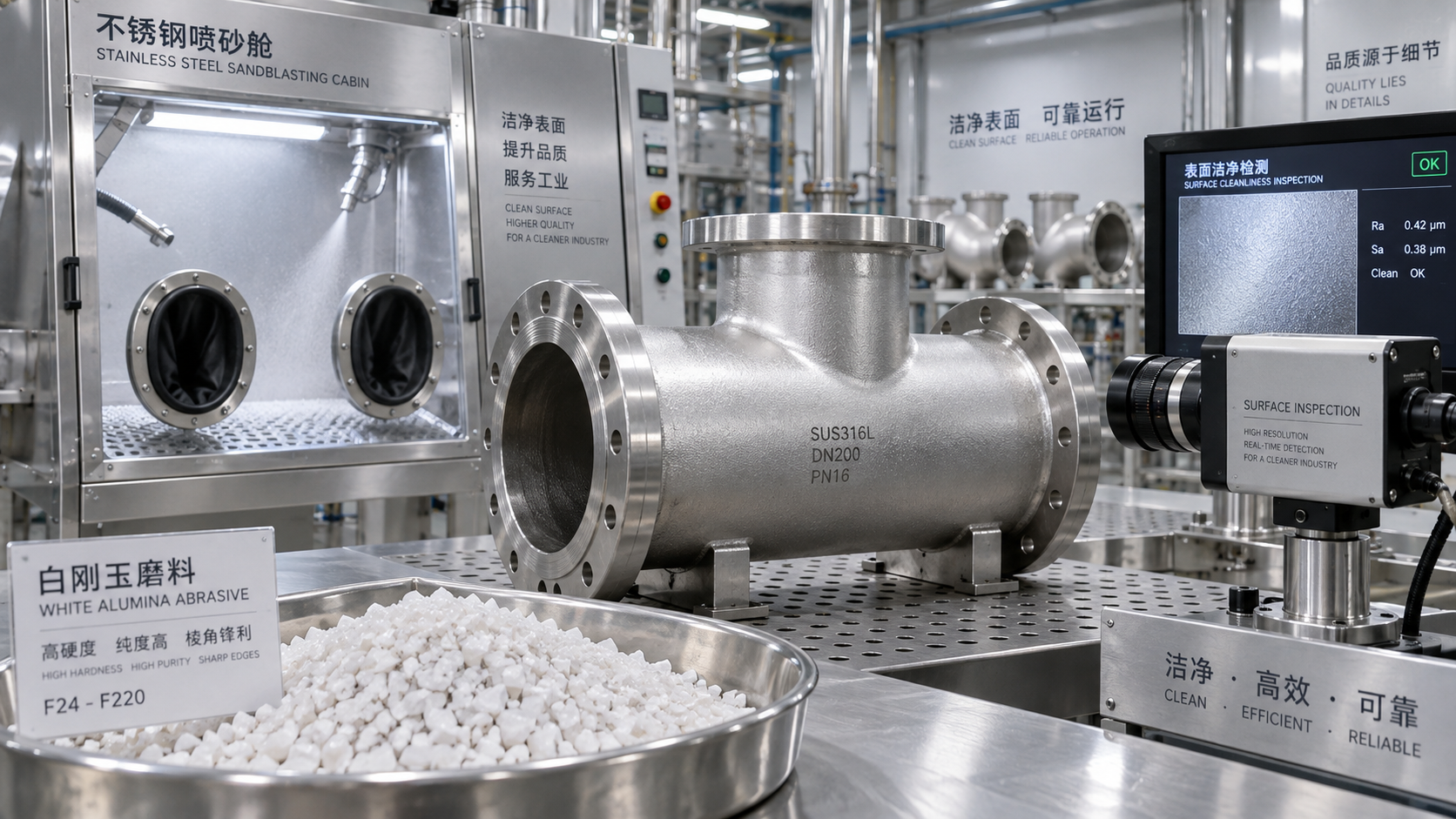
White fused alumina may warrant evaluation where tighter chemistry or contamination requirements apply. Brown fused alumina contains constituents beyond alumina, so colour or a generic “non-metallic” description is not sufficient evidence of suitability for a sensitive alloy or process. Compare the actual chemistry and customer requirements before comparing prices.
Grit specification can change the economics
A quotation for “brown alumina blasting grit” is too broad for a reliable comparison. Particle-size distribution affects impact behaviour, coverage, flow, and the resulting surface profile. Coarser grit is not automatically faster, and finer grit is not automatically cheaper to operate. The right distribution depends on the material being removed, the substrate, and the blasting system.
Confirm which grading convention each supplier uses. Similar-looking grade labels may refer to different distributions under different systems. Request sieve information or an agreed particle-size specification rather than relying on a nominal grit designation alone.
Initial fines, moisture, and oversized particles also deserve attention. Excess fines can increase the dust load; moisture can impair storage and feeding; oversized particles may interfere with stable delivery through the selected equipment. Batch consistency matters because a successful sample trial has limited value if subsequent deliveries require repeated process adjustment.
Do not assume the grade that cuts fastest will deliver the lowest total cost. Its effect on nozzles, hoses, liners, and separator components should be checked against equipment compatibility and maintenance records. A modest productivity improvement can disappear if wear or downtime rises materially.
Use a production trial, not a headline reuse claim
A useful trial compares candidate media on representative parts with comparable incoming surface conditions. Record nozzle condition, operating pressure, abrasive feed, operator method, and the acceptance criteria. Keep the initial comparison controlled, then allow sensible optimisation for each medium; forcing every abrasive to run under unsuitable settings can distort the result.
The measurement sheet should capture:
- Blasting time per accepted part or square metre, including repeat passes.
- Fresh abrasive added, inventory changes, and waste removed over the trial.
- Surface cleanliness, profile, and other specified acceptance checks.
- Dust extraction behaviour, feeding interruptions, and operator visibility.
- Maintenance observations and any downstream coating or cleaning problems.
Run the evaluation long enough to observe the recovered working mix, not just the performance of fresh grit. Account for the initial system charge separately from continuing replenishment. Otherwise, a short trial can make consumption appear either unusually high or artificially low.
Waste classification also requires care. Spent abrasive may contain removed coatings, metals, oils, or other contaminants. Disposal arrangements depend on that combined waste and local requirements, not simply on the unused abrasive’s composition. A safety data sheet is useful, but it does not establish how every spent-media stream should be handled.
Supplier consistency belongs in the cost calculation
Once a grade passes the trial, procurement should protect the conditions that made it successful. Agree on particle-size distribution, chemistry where relevant, packaging, batch identification, and the inspection documents required with each shipment. Ask how deviations are handled and whether a repeat sample can be linked to a production batch.
Shandong Tonghan New Materials Co., Ltd. combines manufacturing and foreign trade in fused alumina abrasives and refractory raw materials. Its operations headquarters in the Liaocheng Development Zone and production base in Chiping support order processing, quality control, production, and export distribution. Its range includes brown fused alumina, white fused alumina, and alumina, allowing buyers to discuss material alternatives when application requirements differ.
That structure is relevant to supply coordination, but supplier selection should still rest on the agreed specification, representative samples, and delivery performance. Compare quotations on the same commercial basis, including freight, duties where applicable, packaging, and delivery terms. A lower factory price may not produce a lower landed cost, particularly when small shipments or urgent replenishment are involved.
The purchasing decision
Brown Fused Alumina is cost-effective when its cutting performance and usable recovery reduce the total cost of meeting the surface specification. It is less compelling when media cannot be recovered, contamination forces early disposal, or the substrate needs a gentler process. No universal reuse count or price threshold resolves those differences.
Before placing a production order, confirm three things: the trial delivered an accepted surface, measured replenishment supports the cost estimate, and the supplier can repeatedly deliver the tested specification. If one remains uncertain, resolve it through a controlled trial or clearer purchase specification rather than treating a cheaper quotation as proof of better value.