


News
Joining hands with partners at home and abroad to create long-term value and achieve a mutually beneficial future for the industry.
Send Us A Message
What causes alumina abrasives to break down during repeated use?
Alumina abrasives break down during repeated use because each impact adds stress to particles that already contain small flaws. Collisions with the workpiece, other grains, and recovery equipment extend those flaws until edges chip or grains split. Continued circulation changes the abrasive size distribution, while rubbing rounds the remaining particles. Excessive impact energy, unsuitable grain toughness, and poorly controlled recycling accelerate this process.
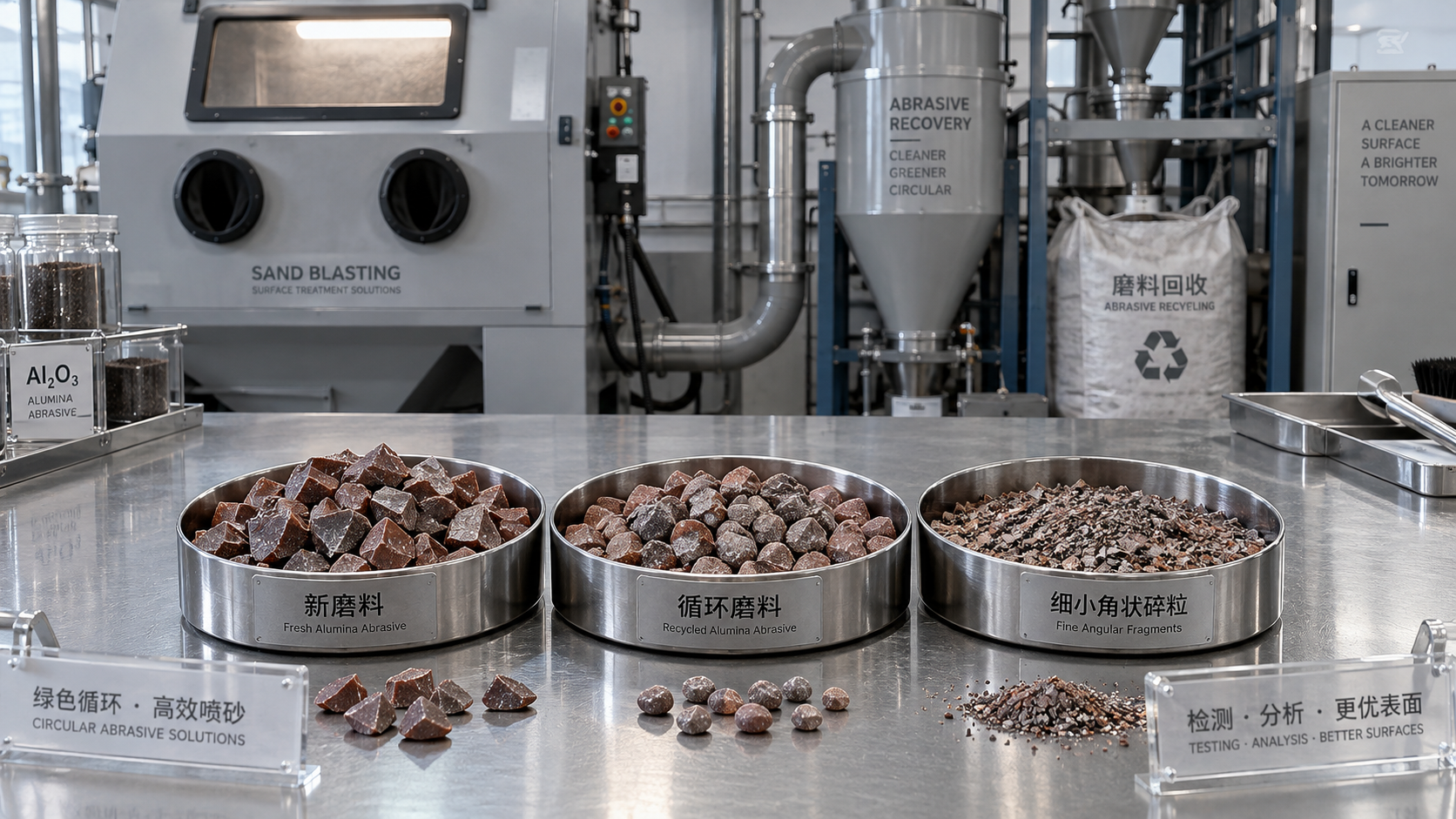
A rise in dust or a fall in cutting speed does not prove that grain fracture is the only problem. Removed coating, rust, trapped moisture, rounded grains, and excessive extraction can produce similar symptoms. The most useful starting point is to compare fresh abrasive, circulating abrasive, and material discharged from the recovery system.
Fracture can restore cutting edges before it becomes waste
Fused alumina is hard enough to scratch and cut many industrial surfaces, but hardness does not make it immune to fracture. Hardness describes resistance to indentation or scratching; toughness describes resistance to crack growth. A grain can retain its hardness while becoming smaller through repeated impacts.
Early edge chipping exposes new sharp surfaces. This controlled fracture helps maintain cutting action, particularly where blunt grains would otherwise rub against the workpiece. Larger fractures become detrimental when the resulting fragments fall below the size needed for the specified surface profile or cleaning rate. Those fragments either remain in circulation with reduced effectiveness or leave through the separator as fines.
Attrition produces a different change: corners gradually wear down without a major split. A rounded grain can remain within the nominal size range yet cut less aggressively. Sieve analysis identifies changes in particle size, but examining grain shape under magnification is necessary to distinguish rounded particles from freshly fractured ones.
Repeated impact also creates cumulative damage. A particle that survives its first pass can carry cracks into later passes. Consequently, the behavior of fresh abrasive does not establish how the circulating mixture will perform after prolonged reuse.
Impact conditions determine how quickly cracks grow
Pressure, velocity, and abrasive flow must be considered together
Higher particle velocity raises impact energy and increases the likelihood of fracture. In compressed-air blasting, raising pressure can improve removal speed initially, but further increases may generate more fines without delivering a useful improvement in cleaning. Compare pressure changes against cleaning time, achieved surface profile, and abrasive consumption together.
The pressure reading at the compressor is insufficient for this comparison. Restrictions, hose length, fittings, air demand, and nozzle condition affect the pressure available during blasting. Use the equipment’s specified measurement method to establish working pressure under flow. A static reading taken while the nozzle is closed can conceal a substantial operating pressure drop.
Nozzle wear changes the air requirement and blasting pattern. If the air supply cannot support the enlarged opening, cutting performance can deteriorate even though the pressure setting has not changed. Increasing pressure to compensate can obscure the underlying equipment problem.
Abrasive feed also affects interpretation. Excessive feed can reduce particle acceleration and increase collisions within the stream. Too little feed reduces productive impacts per unit of time. Keep feed stable when comparing pressures; otherwise, a change in cleaning rate cannot be attributed reliably to pressure alone.
Workpiece material and impact angle change the loading
Hard, rigid surfaces provide less deformation to absorb an impact, increasing the stress experienced by the grain. Tough scale, hard coatings, and already exposed substrate can therefore produce different breakdown rates within the same job. Continued blasting after a coating has been removed exposes the abrasive to additional impacts without advancing the cleaning requirement.
An impact close to perpendicular places a stronger normal load on the particle, encouraging indentation and fracture. A more oblique angle introduces greater sliding action, which can favor cutting certain coatings while changing the resulting profile. Angle adjustments must preserve the required finish and coverage; reducing breakage alone is not a sufficient reason to change an established process.
Stand-off distance affects stream concentration, coverage, and particle conditions at impact. Its effect cannot be reduced to a universal rule that closer or farther always produces less breakdown. Hold distance and nozzle movement consistent during comparisons, especially when assessing whether a pressure reduction has improved usable abrasive life.
Grain selection changes the balance between sharpness and survival
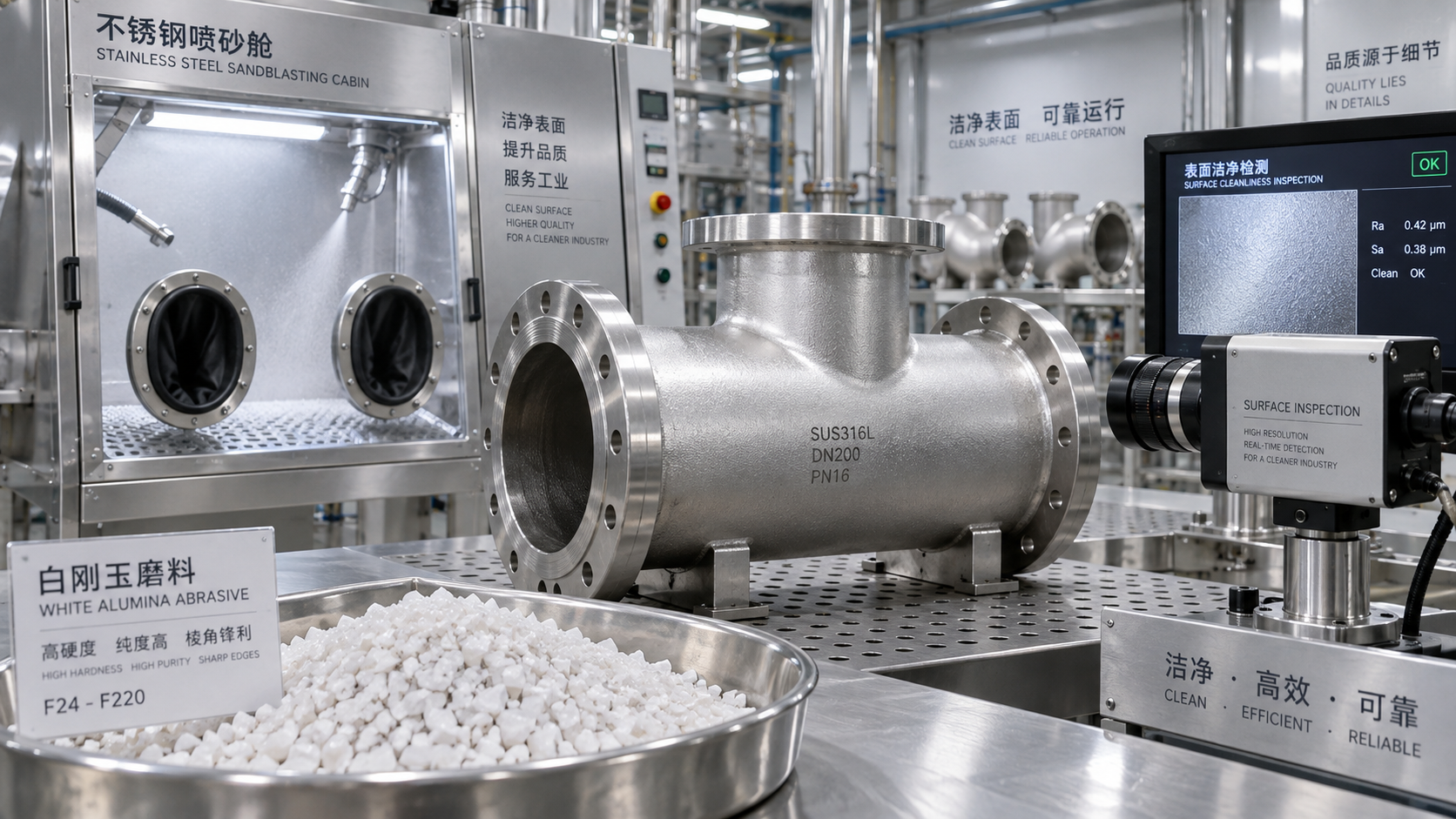
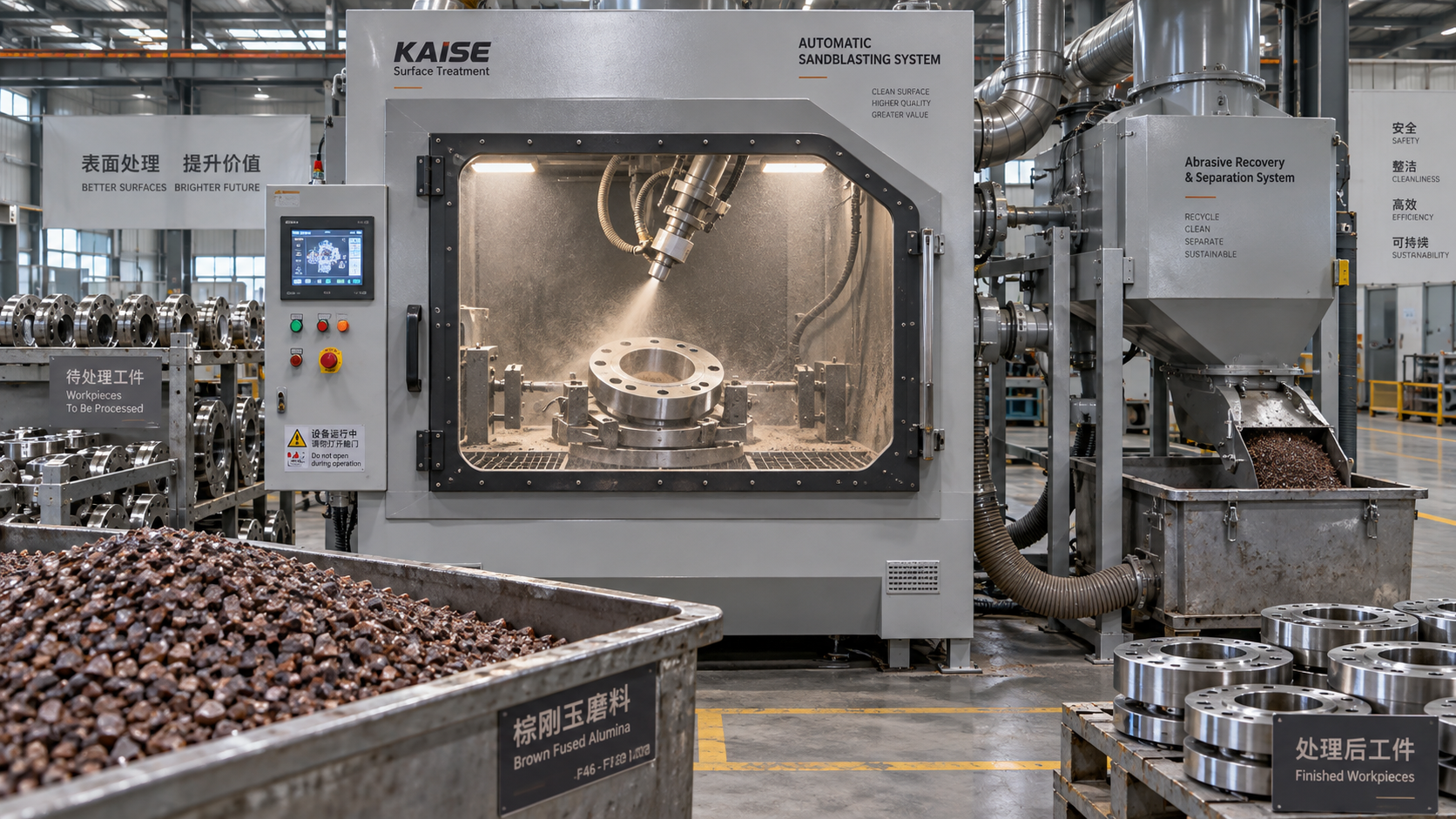
White fused alumina generally fractures more readily than conventional brown fused alumina, which is commonly selected where greater grain toughness is useful. The distinction is a starting point rather than a guaranteed service-life ranking. Grain microstructure, manufacturing route, treatment, crushing method, and size distribution influence the behavior of a particular grade.
A more friable abrasive can be effective when frequent exposure of sharp edges supports the required cutting action. A tougher grade can tolerate repeated circulation better, but worn particles may remain in the system after their cutting efficiency has declined. Compare usable performance across repeated passes rather than judging suitability solely by how much material survives.
Particle size adds another trade-off. At equal velocity, a larger particle carries more kinetic energy because it has greater mass. It can produce a deeper profile, but it also experiences a more energetic collision. Starting with coarser material to compensate for rapid breakdown can create an excessive initial profile and does not correct unsuitable pressure or recovery conditions.
A nominal grit designation alone does not describe the complete working mixture. Two batches with the same designation can differ in their distribution of coarse particles and fines. Compare incoming sieve results with the agreed specification, and retain a fresh sample for reference. For recycled blasting, the distribution maintained during operation matters as much as the starting grade.
The recovery circuit can damage grains and remove useful material
Abrasive continues to experience impacts after it leaves the workpiece. Depending on equipment design, pneumatic transfer lines, sharp bends, screws, elevators, and hard landing surfaces introduce additional collisions. A change in transport velocity, a damaged lining, or an altered recovery route can increase breakdown even when blasting settings remain constant.
Sampling at different points helps locate this damage. If material collected immediately after blasting remains relatively coarse but material returning to the hopper contains more fines, investigate the recovery path. Take samples at comparable operating conditions; settling and size segregation can make an isolated scoop unrepresentative.
The separator creates a separate source of apparent consumption. Excessive extraction can carry useful abrasive into the dust collector. Insufficient separation leaves fines in circulation, changing the cutting mixture and increasing dust at the work area. The correct setting must remove unwanted material while retaining the particle sizes needed for the process.
Dust collector contents need to be interpreted carefully. They can contain fractured alumina, coating debris, rust, and substrate particles. A larger waste volume during heavy coating removal does not automatically indicate poorer abrasive durability. Examine the waste alongside circulating media, and distinguish intact grains from genuinely fine fragments.
Moisture and oil contamination primarily cause clumping, irregular feeding, and separation problems. Ordinary moisture exposure does not explain rapid fracture of fused alumina in a blasting circuit. Correct compressed-air treatment and dry storage when feed becomes unstable, but investigate mechanical loading separately if grain fragmentation continues.
Use the symptom pattern to narrow the cause
Several causes can occur together. Rounded grains may coexist with fragments, while extraction removes part of both populations. A single dust measurement or hopper-level reading cannot resolve that combination.
A controlled trial reveals which adjustment is worthwhile
Begin with a stable operating condition and a representative workpiece. Record the abrasive grade, working pressure, nozzle condition, feed setting, stand-off distance, separator setting, and fresh makeup added. Measure performance using the actual acceptance criteria, such as cleaning quality, surface profile, or finishing time.
- Collect fresh abrasive, circulating media, and separator discharge. Use consistent sampling locations and methods, then compare size distribution and grain shape.
- If impact fracture dominates, test a modest pressure reduction while holding feed, angle, and distance steady. Confirm that the required finish is still achieved.
- Where useful grains appear in the waste stream, adjust separation within the equipment’s operating guidance and reassess both waste composition and circulating fines.
- A grade comparison comes after obvious equipment and circulation problems are resolved. Evaluate repeated use over comparable processed area or work quantity.
Counting reuse cycles alone gives an incomplete measure of durability. One cycle through a lightly loaded cabinet differs from a cycle spent removing tenacious scale over a large surface. Abrasive additions also change the mixture continuously, so apparent long life may reflect frequent replenishment. Record makeup consumption alongside accepted work output.
There is no universal replacement interval for alumina media. Useful life ends when the circulating mixture can no longer maintain the required removal rate and finish under stable, appropriate settings. Where fracture is controlled but the mixture keeps getting finer, establish a consistent fines-removal and fresh-makeup routine. This keeps the process within its working particle-size range instead of waiting for cutting performance to collapse.