


News
Joining hands with partners at home and abroad to create long-term value and achieve a mutually beneficial future for the industry.
Send Us A Message
Can white fused alumina cause iron contamination on stainless steel?
Can white fused alumina cause iron contamination on stainless steel?
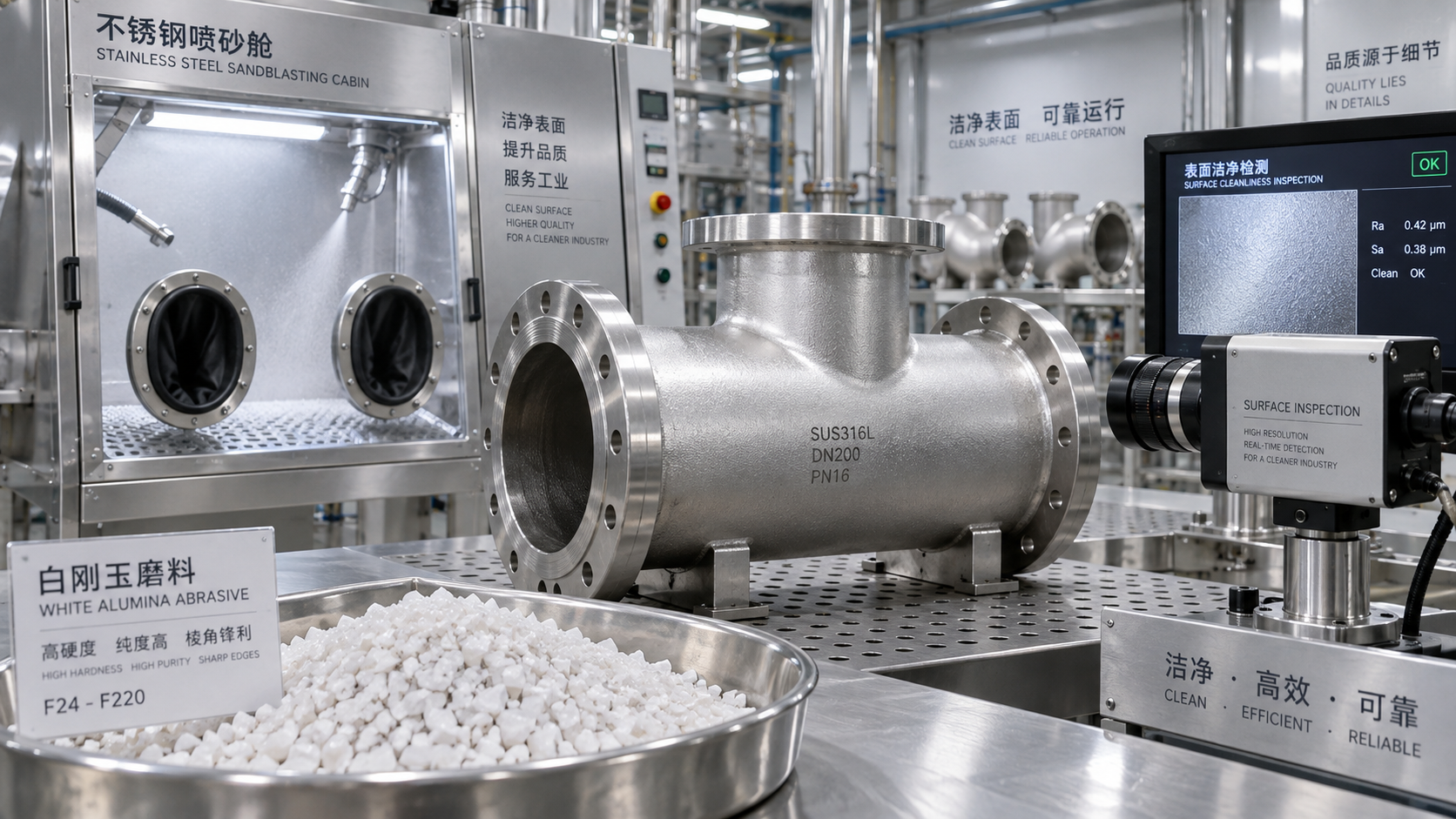
Yes—White Fused Alumina can contribute to iron contamination on stainless steel if the abrasive contains iron-bearing impurities or picks up metallic particles during use. Its low iron content makes it a common choice for blasting and surface preparation, but abrasive purity alone does not eliminate contamination risks. Recycled media, shared equipment, and improper handling can undermine an otherwise suitable material.
For chemical-processing equipment, the distinction matters. A clean-looking blasted surface is not necessarily free of embedded iron, and a supplier’s chemical analysis does not prove that the finished vessel or pipework is uncontaminated. Reliable acceptance requires control of the abrasive, the blasting circuit, and the inspection method.
Low iron content is not the same as freedom from free iron
White fused alumina is an aluminum oxide abrasive produced by electrically fusing alumina feedstock. Unlike steel grit, its principal constituent is not metallic iron. That makes it a reasonable candidate where transferring ferrous material onto stainless steel would be unacceptable.
However, “iron content” can describe different things. A laboratory report may express iron as Fe₂O₃, while the practical concern at the workpiece is often free metallic iron or carbon-steel debris. A total iron result does not, by itself, distinguish how much iron is present as oxide, as another impurity, or as loose metallic contamination.
Stainless steel already contains iron as part of its alloy. The problem is not that iron exists in the material; it is that foreign iron-bearing particles can remain on or become embedded in the surface. Exposed carbon-steel particles may rust under conditions where the stainless substrate would otherwise remain serviceable.
That rust can create staining, contaminate process-contact surfaces, and complicate corrosion assessment. Whether localized corrosion develops also depends on alloy grade, chlorides, temperature, surface condition, and service chemistry. Rust spots should therefore trigger investigation, not an automatic conclusion that the stainless steel itself has failed.
Where contamination enters the blasting process
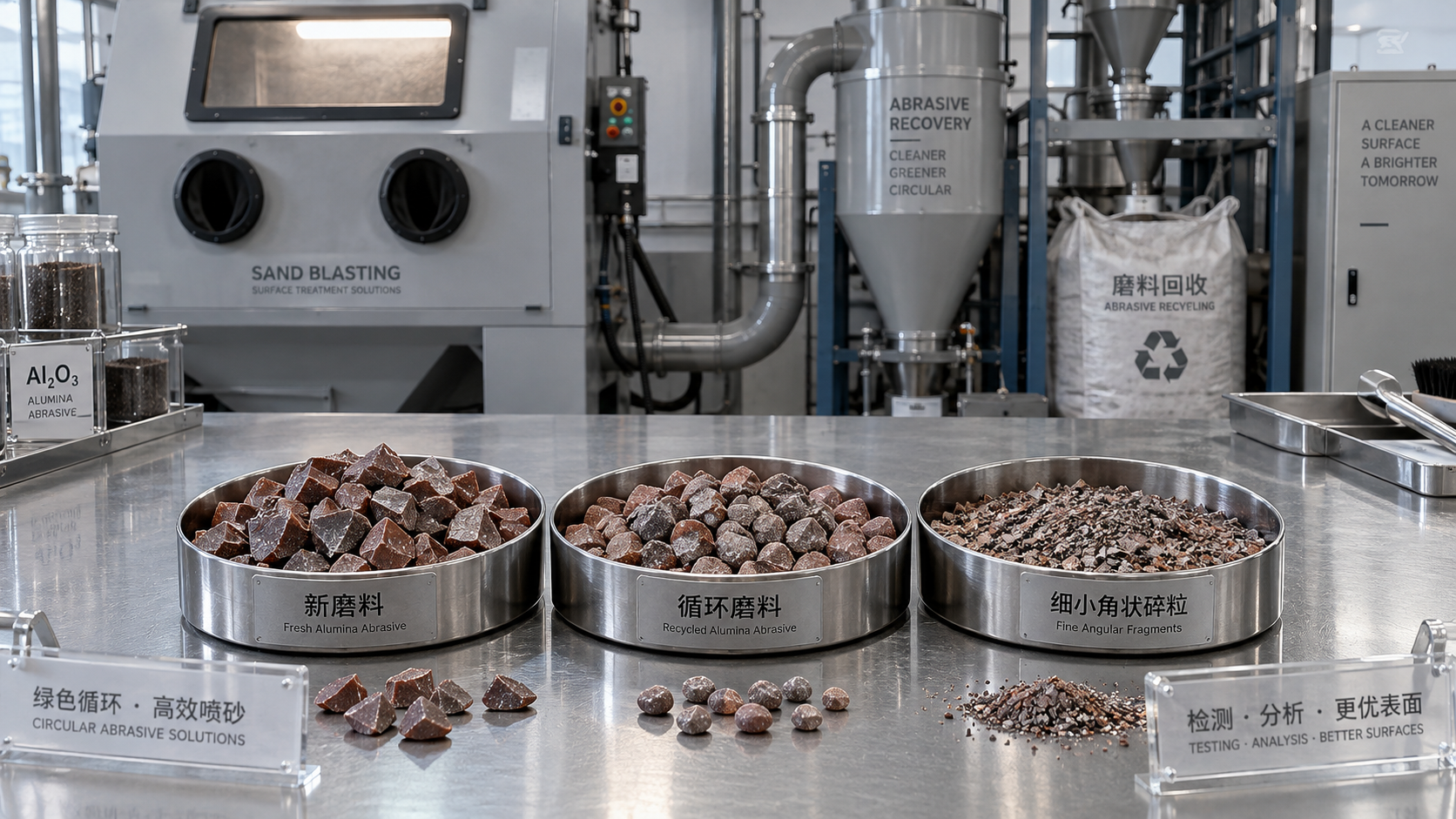
The most significant risk may arise after the abrasive leaves its packaging. Media used on carbon steel can collect steel fragments, rust, and scale. Returning that material to a recovery system and then blasting stainless steel creates a transfer route—even when the original abrasive met the purchase specification.
Screening removes particles according to size; it does not reliably separate every iron-bearing fragment from useful abrasive. Magnetic separation can reduce some ferrous debris, but performance depends on particle characteristics and separator design. Neither measure should be treated as proof that reclaimed media is suitable for contamination-sensitive stainless work.
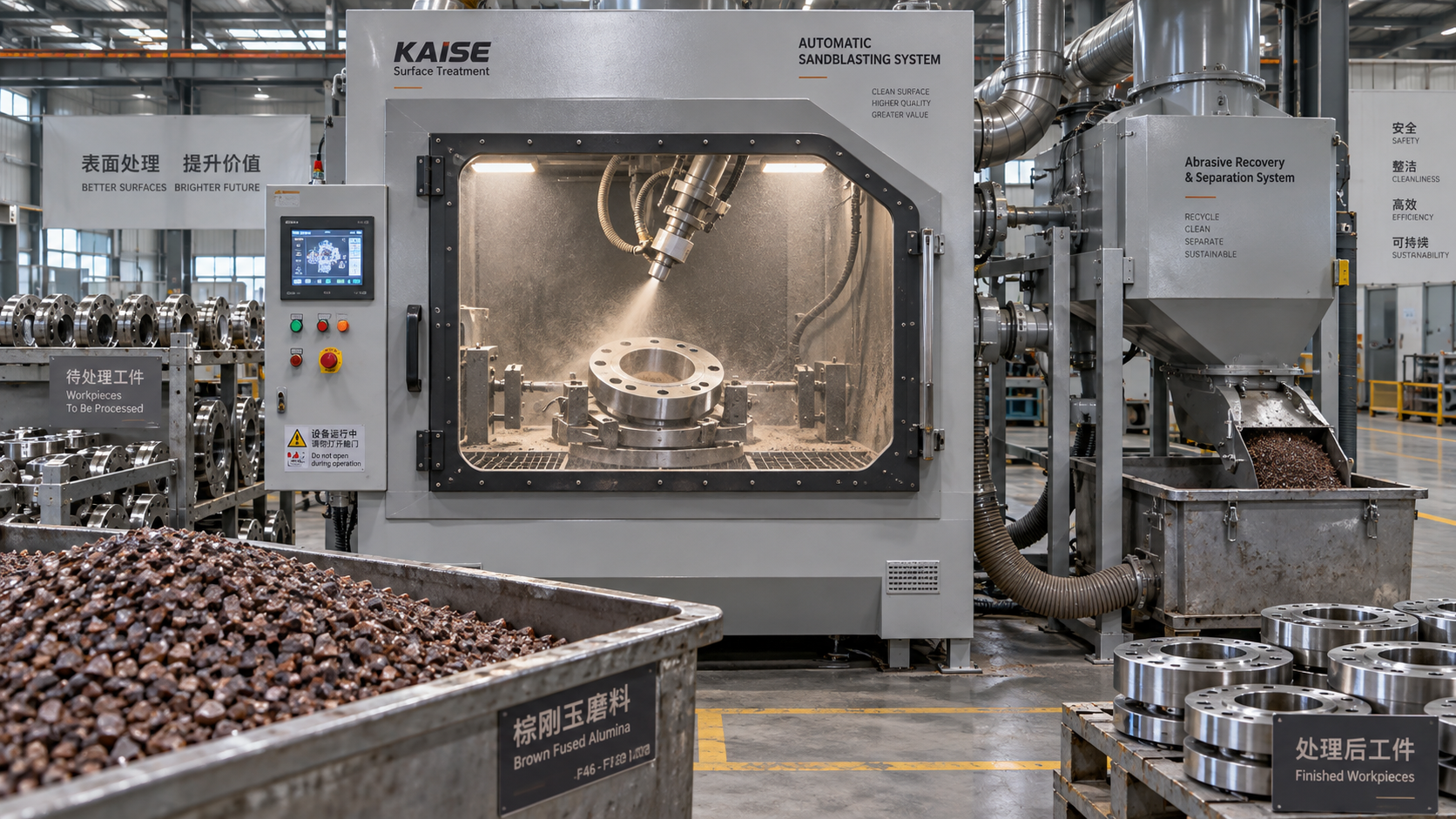
Shared blast rooms introduce further uncertainty. Residual media in hoppers, reclaim ducts, hoses, and floor recovery systems can mix with a fresh charge. Ferrous fixtures, worn equipment components, and nearby grinding operations may contribute particles. A nominally “nonmetallic abrasive” process can still have several metallic contamination sources.
Handling after blasting also matters. Carbon-steel brushes, dirty lifting accessories, shared workbenches, or grinding dust settling on an exposed surface can undo careful preparation. For chemical equipment fabrication, the protected stainless-work area should extend beyond the blast enclosure to inspection, cleaning, and storage.
What to request from the abrasive supplier
A useful purchase specification goes beyond “high-purity alumina.” It identifies the blasting application, required particle-size distribution, relevant impurity limits, and how compliance will be demonstrated. No single iron limit is suitable for every stainless-steel project; the requirement should reflect the service environment and the customer’s acceptance criteria.
- Batch-specific chemistry: Request reported aluminum oxide and relevant impurities, with the analytical basis clearly stated. Confirm whether iron is reported as elemental Fe or as Fe₂O₃.
- Metallic contamination controls: Ask how production, conveying, screening, and packing limit foreign ferrous material. Bulk chemistry and loose metallic contamination are separate questions.
- Grading: Specify the particle-size distribution or recognized grading designation, rather than relying on an ambiguous mesh description.
- Packaging and traceability: Require identifiable lots and packaging that protects against moisture and cross-contamination during transport and storage.
- Additional cleanliness requirements: Where service conditions justify them, define requirements for water-soluble salts, conductivity, or other contaminants using agreed test methods.
For pneumatic blast-cleaning applications, ISO 11126-7 addresses fused aluminum oxide abrasives, while the ISO 11127 series provides test methods for nonmetallic blast-cleaning abrasives. The applicable editions and individual tests should be checked against the project specification. These references help define abrasive quality; they do not certify the cleanliness of the finished stainless surface.
Shandong Tonghan New Materials Co., Ltd. manufactures and exports white fused alumina, brown fused alumina, and alumina products, with an operations headquarters in Liaocheng and a production base in Chiping. For stainless-steel work, that product range makes precise grade identification important: materials intended for refractory use, general grinding, and controlled blasting should not be treated as interchangeable merely because they belong to the alumina family.
A practical supplier discussion should connect batch documentation, grading, packaging, and order traceability to the actual blasting requirement. Manufacturing and export coordination can support that process, but neither company scale nor a broad catalog replaces an application-specific acceptance specification.
Verify the surface—not just the delivery certificate
Incoming abrasive inspection and finished-surface verification answer different questions. The former checks whether the supplied media meets agreed requirements. The latter checks whether fabrication and cleaning left the stainless steel in an acceptable condition. Both may be necessary for process-contact equipment.
ASTM A380/A380M provides guidance on cleaning, descaling, and passivation of stainless-steel parts, equipment, and systems. ASTM A967/A967M covers chemical passivation treatments for stainless-steel parts and includes alternative verification practices. Their scope, applicable procedures, and acceptance provisions should be reviewed before incorporating them into an inspection plan.
Free-iron checks can include specified ferroxyl or copper sulfate procedures where appropriate. Test selection depends on the stainless grade, component condition, governing requirements, and compatibility with subsequent service. These are controlled chemical tests—not informal spot checks to improvise on production equipment.
Define the inspection locations, sampling extent, timing, and response to a positive result before blasting begins. Weld-adjacent areas, recesses, and surfaces exposed to shared fixtures deserve attention, but the inspection plan should reflect the component’s geometry and fabrication history rather than a universal sampling pattern.
Visual inspection remains useful for identifying rust, residue, and uneven preparation, but appearance alone cannot establish freedom from free iron. Where particle origin is disputed, microscopy with elemental analysis may help distinguish alumina residue from iron-bearing debris. Such analysis supplements the agreed acceptance tests; it should not silently replace them.
Build contamination control into the work sequence
For contamination-sensitive work, dedicated media and a segregated blasting system are generally easier to validate than repeated changeovers between carbon steel and stainless steel. If sharing is unavoidable, establish a documented cleanout procedure and verify its effectiveness. Loading fresh abrasive into a contaminated reclaim circuit is not a clean changeover.
Qualification trials should use the intended stainless grade and representative process settings. Pressure, particle size, impact angle, and exposure time influence roughness and the possibility of particle retention. More aggressive blasting is not automatically better, particularly on thin sections, sealing faces, or surfaces subject to a defined finish requirement.
After blasting, remove loose abrasive and dust using an approved cleaning method. Compressed air used for cleaning should be checked for relevant contamination, including oil and moisture. Keep cleaned parts away from ferrous fabrication dust and protect them during movement and storage.
If embedded iron is detected, simply blasting again may repeat the problem. Investigate the source, correct the process, and select a qualified cleaning or chemical treatment. Passivation is not a substitute for removing heavy deposits, scale, or embedded debris. Pickling and passivation also serve different purposes and should not be casually substituted for each other.
Surface cleanliness and worker safety need separate controls
Low iron content does not make blasting dust harmless. Exposure can arise from abrasive fines, removed coatings, and substrate particles. Safety assessment should consider the abrasive safety data sheet, the material being removed, ventilation, dust collection, respiratory protection, and applicable workplace exposure requirements.
Chemical verification and remedial cleaning introduce additional hazards. Test reagents and treatment solutions need controlled handling, suitable protective equipment, rinsing procedures, and waste management. Reagent residues must not become a new source of contamination on process-contact surfaces.
When is white fused alumina an acceptable choice?
White Fused Alumina is a defensible choice when its batch quality is documented, the blasting circuit is controlled, and the resulting stainless surface meets the project’s cleanliness and finish requirements. It is not defensible solely because the abrasive is white, described as high purity, or accompanied by a low Fe₂O₃ result.
Before releasing chemical-processing equipment, confirm three things: what the abrasive certificate establishes, how contamination was prevented during fabrication, and which surface test supports acceptance. If one of those answers is missing, resolve it before service rather than relying on appearance or waiting for rust staining to reveal the gap.